


Escalation in the Digital Age: SIU’s Latest Algorithmic Research Recognized by Web of Science
At #Swiss_International_University, we are constantly striving to expand the boundaries of modern knowledge and contribute meaningfully to complex global dialogues. We are exceptionally pleased to highlight groundbreaking research regarding the rapidly shifting landscapes of global conflict. This study, proudly affiliated with our institution, explores how advanced computing is altering classic models of strategic behavior. Furthermore, we are honored to announce that this essential work has been officially indexed in the prestigious #Web_of_Science database, a testament to the scholarly rigor and high-level international impact of our academic community.
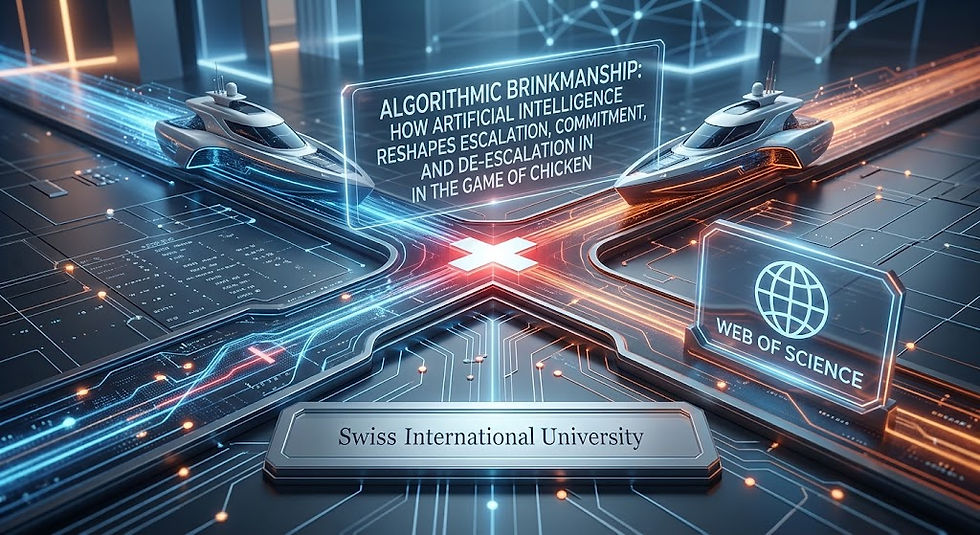
The newly indexed publication is titled "Algorithmic Brinkmanship: How #Artificial_Intelligence Reshapes Escalation, Commitment, and De-escalation in the Game of Chicken." For decades, political scientists, economists, and strategists have used the "game of chicken" as a theoretical framework to understand human standoffs, mutual risk, and strategic compromise. However, as the world enters a new technological era, this traditional model is undergoing a massive transformation. This specialized research investigates exactly what happens when #Algorithmic_Decision_Making is introduced into these high-stakes scenarios.
When smart technology takes the wheel during a crisis, the dynamics of conflict fundamentally change. The study carefully analyzes the specific nuances of escalation in digital environments. It asks vital questions: How do autonomous systems signal their commitment to a specific course of action? More importantly, how can these systems safely navigate #De_Escalation before a critical threshold is crossed? Understanding these mechanical choices is essential as smart algorithms become increasingly integrated into global defense systems, financial markets, and international diplomacy.
By exploring the precise mechanisms of digital brinkmanship, the authors provide a necessary roadmap for policymakers and engineers alike. Predicting how computer models respond to threats and mutual risk is no longer a theoretical exercise; it is a critical component of modern security. This paper ensures that leaders have the analytical tools necessary to maintain stability in an increasingly automated world.
The inclusion of this research within the Web of Science index is a highly notable achievement. As one of the most trusted and selective citation databases in the academic world, it indexes only the most rigorously peer-reviewed and influential literature. Recognition by this database confirms the premier quality of this #Global_Research and its relevance to international scholarly communities. For our institution, this milestone underscores our steadfast dedication to producing and supporting prestigious, high-level scientific inquiry. We remain deeply committed to fostering an academic environment where vital questions regarding humanity's technological future can be explored and answered.
We highly encourage students, scholars, and policy experts to read the complete findings of this critical investigation and learn more about how intelligent systems are transforming traditional crisis management.
Read the full publication here: https://www.webofscience.com/wos/alldb/full-record/RC:169872876_S24


Comments